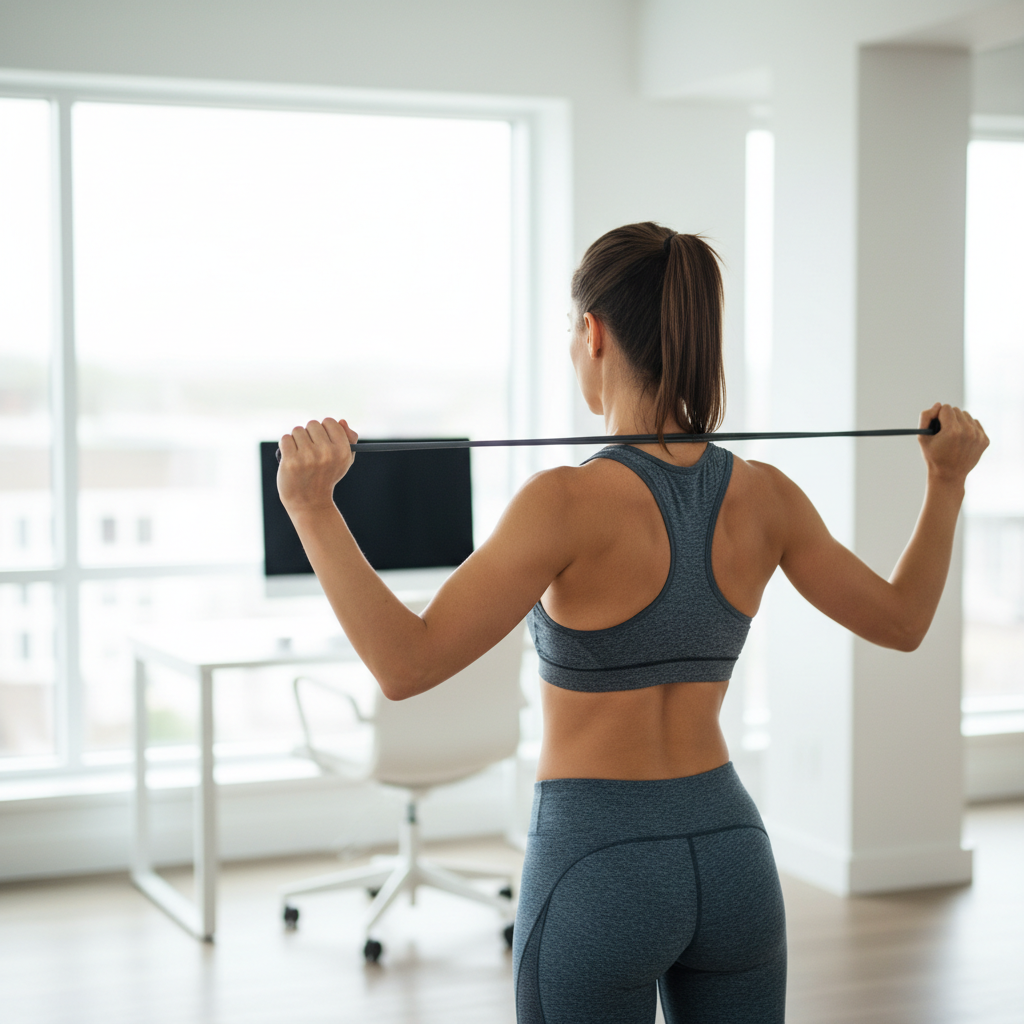
The Modern Epidemic: Understanding “Desk Posture”
In my 20+ years as a sports scientist, I've seen training trends come and go. But one problem has only grown more prevalent: the rounded, forward-head posture often dubbed “tech neck” or “desk posture.” It’s characterized by slumped shoulders, a curved upper back (thoracic kyphosis), and a head that juts forward. This isn't just an aesthetic concern; it's a structural imbalance that can sabotage your training, cause chronic pain, and limit your overall physical potential.
This condition is clinically known as Upper Crossed Syndrome. Imagine an 'X' drawn across your upper torso. One line represents overactive, tight muscles: your pectoral (chest) muscles and your upper trapezius/levator scapulae (upper back and neck). The other line represents underactive, weak muscles: your deep neck flexors at the front of your neck, and your rhomboids and lower/mid trapezius in your mid-back. This imbalance pulls your skeleton out of alignment, creating a cascade of biomechanical issues. Before beginning any new routine, it's wise to understand your current physical state. We encourage you to review our health disclaimer and PAR-Q screening to ensure you're ready for exercise.
Why Poor Posture Sabotages Your Fitness Goals
Think of your body as a high-performance machine. If the chassis is bent, the engine can't deliver its full power. Poor posture is that bent chassis. When your shoulders are rolled forward, it mechanically blocks proper overhead movement, increasing the risk of shoulder impingement when performing exercises like the overhead press. The forward head position can add up to 60 pounds of effective weight on your cervical spine, leading to neck pain, tension headaches, and decreased nerve function.
In the gym, this imbalance manifests in predictable ways. You might struggle to 'feel' your back muscles working during rows because your overactive upper traps take over. You might find your bench press stalls because your tight chest and weak back prevent proper scapular retraction, a key component for both safety and strength. Correcting posture isn't just about standing taller; it's about unlocking your body's true capacity for strength and performance. It's about creating a stable foundation from which you can move with power and efficiency.
The Corrective Exercise Blueprint: Pull More, Sit Less
The solution lies in reversing the pattern of imbalance. We need to systematically strengthen the weakened posterior chain muscles and mobilize the chronically tight anterior muscles. The simple mantra is: strengthen what's weak, and stretch what's tight. For most people with desk posture, this means focusing more on pulling exercises than pushing exercises.
Our primary targets for strengthening are:
- Rhomboids and Mid/Lower Trapezius: The muscles responsible for pulling your shoulder blades together and down, countering the forward slump.
- Rear Deltoids and External Rotators: These muscles on the back of your shoulders help pull the head of the humerus (upper arm bone) back into its socket.
- Serratus Anterior: A key muscle that helps keep your scapula flush against your ribcage, preventing 'winging'.
- Deep Neck Flexors: The small muscles at the front of your neck that retract your head and support your cervical spine.
Key Exercises to Realign Your Body
Here are four powerful exercises to incorporate into your routine. Focus on control and quality of movement over heavy weight. The goal is activation and endurance in these often-neglected muscles.
1. The Face Pull
This is arguably the king of postural exercises. It directly targets the rear delts, rhomboids, and external rotators.
- Set a cable rope attachment at chest height.
- Grasp the ropes with an overhand grip, thumbs pointing towards you.
- Step back to create tension. Brace your core and keep your chest up.
- Pull the ropes towards your face, aiming to get your hands on either side of your ears.
- As you pull, actively think about squeezing your shoulder blades together and rotating your arms externally (thumbs pointing back).
- Pause for a second at the peak contraction, then slowly control the weight back to the start.
2. Band Pull-Aparts
A simple, effective movement you can do anywhere with a resistance band.
- Hold a light resistance band with both hands, arms straight out in front of you at shoulder height, palms facing down.
- Keeping your arms straight, pull the band apart by squeezing your shoulder blades together.
- Imagine you're trying to pinch a pencil between your scapulae. Avoid shrugging your shoulders up towards your ears.
- Hold the peak contraction briefly before returning to the starting position with control.
3. Scapular Wall Slides
This exercise is excellent for activating the lower traps and serratus anterior without any equipment.
- Stand with your back against a wall, with your feet about six inches away from it.
- Try to have your tailbone, mid-back, and head touching the wall.
- Place your forearms on the wall in a 'goalpost' position, with elbows and wrists touching the wall if possible.
- Slowly slide your arms up the wall, maintaining contact with your wrists and elbows for as long as you can.
- Slide up only as far as you can without your lower back arching or your elbows lifting off the wall.
- Slowly slide back down to the starting position.
4. Chin Tucks
This targets the weak deep neck flexors to combat forward head posture.
- Sit or stand tall, looking straight ahead.
- Gently tuck your chin towards your neck, as if you're trying to make a double chin.
- You should feel a stretch at the base of your skull and an activation in the muscles at the front of your neck.
- Hold for 5 seconds, then relax. Avoid looking down; the movement is a horizontal retraction.
Integrating Posture Work Into Your Training
Consistency is more important than intensity. You don't need to dedicate an entire day to posture. Instead, sprinkle these movements throughout your week.
- As a Warm-Up: Perform 2-3 sets of 15-20 reps of Band Pull-Aparts and some Chin Tucks before every upper body workout to prime the correct muscles.
- As an Accessory: Add 3-4 sets of 12-15 reps of Face Pulls to the end of your push or pull days.
- On Rest Days: Do a circuit of Wall Slides and Chin Tucks to actively recover and reinforce good patterns.
A well-rounded fitness plan should inherently support good posture by balancing pushing and pulling movements. Our SmartyGym training programs are built on these principles of structural balance, ensuring you're building a body that's as resilient as it is strong. By consciously adding these corrective drills, you accelerate the process of unwinding years of desk-bound habits.
Beyond the Gym: Building a Posture-Perfect Lifestyle
While these exercises are powerfully effective, they fight an uphill battle if your daily environment is constantly reinforcing poor posture. Be mindful of your ergonomics. Adjust your monitor so the top is at eye level. Use a chair that supports your lumbar curve. Most importantly, move often. Set a timer to get up, walk, and stretch every 30-60 minutes. Rebuilding your posture is a 24/7 commitment, but the payoff—a pain-free, stronger, and more confident you—is worth every effort. Start with these foundational exercises, stay consistent, and you'll not only look better, you'll move and feel better for years to come.