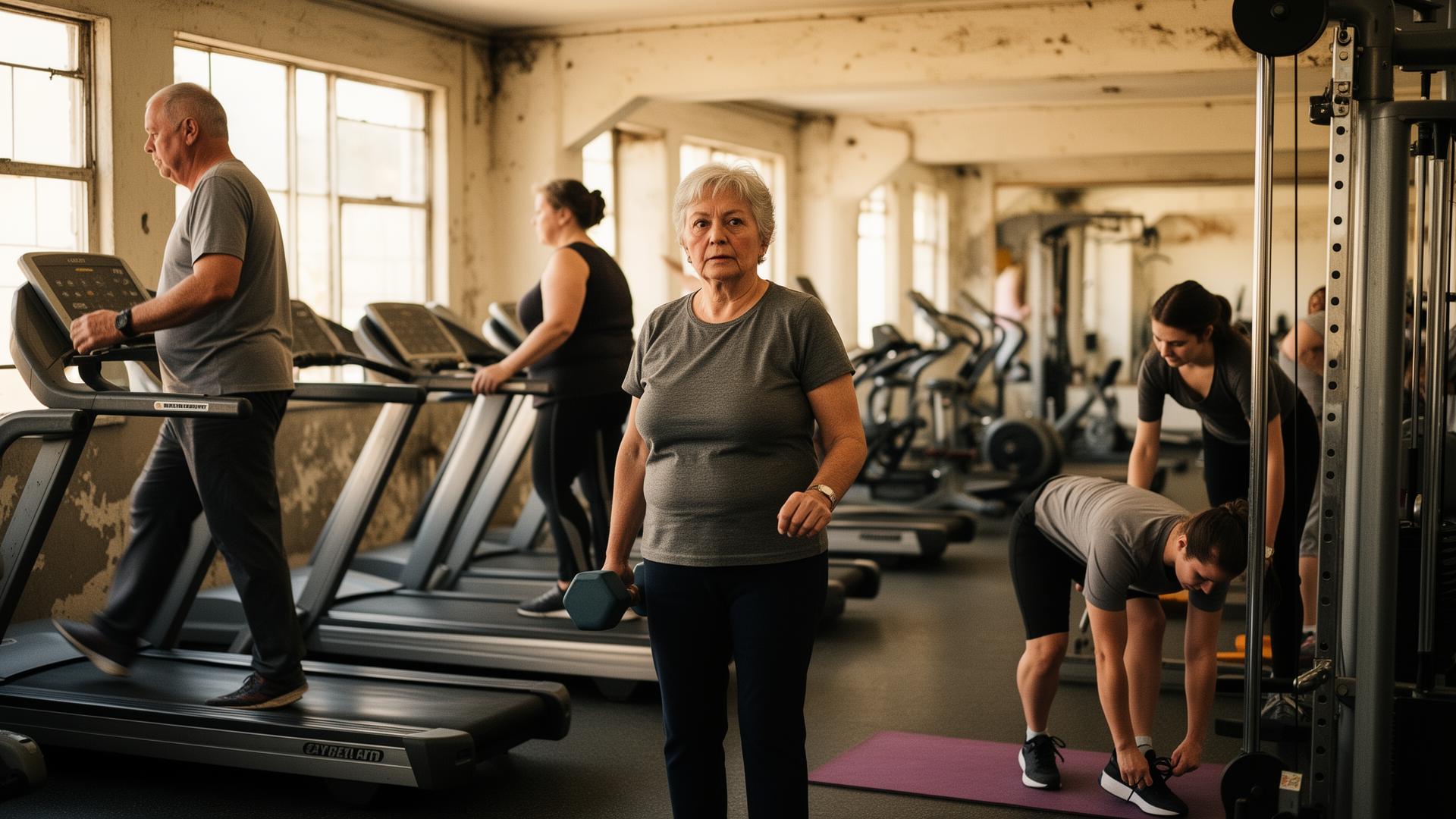
I have been coaching real people for more than twenty years, and I will tell you something that I have come to believe with absolute certainty: sooner or later, every human being on this planet ends up in a gym. Not necessarily this gym. Not necessarily a fancy one. But somewhere — a clinic, a rehab room, a community center, a corner of their living room with a yoga mat and a pair of dumbbells — every single person eventually finds themselves training their body on purpose. The only real question is which door they walk through to get there.
There are two doors. One you open yourself. The other gets opened for you by a doctor holding a clipboard and a worried face. This article is a quiet, honest message about why you really, really want to be the person who chooses the first door.
Door #1: You walk in because you decided to
This is the door I want you to use. The person who walks through it is not necessarily an athlete. They are not necessarily lean, strong, young, or "ready." They are simply someone who, at some point in their life, made a quiet decision: I am going to take care of this body before it forces me to.
People walk through Door #1 for all kinds of beautiful, ordinary reasons. They want to feel more energy when they wake up. They want to keep up with their kids in the park without their lower back screaming. They want to look in the mirror and recognize the person standing there. They want to put on the clothes they love. They want to play a sport without getting injured every season. They want to be the parent who carries the suitcases, hikes the trail, dances at the wedding, picks up the grandkid. They want confidence — not the loud, posing kind, but the calm kind that comes from knowing your body is on your side.
Some of them are exploring. They want to find out what their body can actually do. How heavy can I lift? How long can I run? How well can I move at 50, at 60, at 70? That curiosity is one of the most underrated drivers of a long, healthy life. If you want a starting point, the One Rep Max Calculator and the BMR Calculator are quiet little mirrors that show you where you stand today — not to judge you, but to give you a baseline you can beat.
Door #1 is the door of investment. You put in time, sweat, attention, and a bit of discomfort, and over months and years you compound a return that no financial account in the world can match: a body that still works, a mind that still feels sharp, a life that still feels like yours.
Door #2: The doctor sends you
Door #2 is the one nobody wants to use, and yet most people end up using it. It usually opens after a regular check-up that wasn't supposed to be a big deal. Blood pressure is high. Cholesterol is creeping. Blood sugar is on the wrong side of the line. The scan shows the beginning of osteoporosis. The knee has chondromalacia. The shoulder has a frozen capsule. The neck has years of office posture compressed into it. The lower back has decided it is no longer interested in negotiations.
And the doctor, who has seen this movie a thousand times, leans forward and says some version of the same sentence: "You need to start exercising. Seriously."
Sometimes the words are softer — "be more active," "lose some weight," "build some muscle." Sometimes they are sharper — "if you don't, we are looking at medication, or worse." Either way, the message is the same: your body is asking, through your doctor, for the thing you didn't give it on your own.
Exercise here is no longer optional. It is no longer a lifestyle aesthetic. It is, plainly, medicine. Strength training rebuilds bone density in osteoporosis. Aerobic work lowers blood pressure and improves heart health. Loaded movement is one of the most powerful tools we have against arthritis pain, against insulin resistance, against sarcopenia, against the slow erosion that we politely call "aging." Even patients walking into the gym with a frightening diagnosis in their hand often walk out, months later, with better numbers than they had a decade earlier. Bodies are forgiving. They are also patient — until they are not.
Why Door #1 is the smarter door
Both doors lead to the same room. So why does it matter which one you use? Because the price is wildly different.
- You keep your agency. Through Door #1, you train because you chose to. Through Door #2, you train because you have to. Same gym. Very different feeling.
- You train before the damage. It is much, much easier to maintain a strong back than to rebuild one after a herniated disc. It is far easier to keep your bones dense than to recover them after a fracture. Prevention is almost free. Repair is expensive — in time, in money, in pain.
- You compound the results. A 35-year-old who lifts twice a week is buying themselves a 65-year-old body that still climbs stairs without thinking. A 45-year-old who walks daily is buying themselves a 75-year-old brain that still remembers names. Every session is a tiny deposit into a very long-term account.
- Recovery is easier. A healthy body bounces back from training in 24–48 hours. A sick body needs weeks. The earlier you start, the cheaper every session is — biologically and emotionally.
- You change your identity. Door #1 turns you into "someone who trains." Door #2 turns you into "a patient with a prescription." Both can lead to health, but only one feels like freedom.
I am not romanticizing Door #1. It is still hard. There are days you don't want to go. There are sessions that feel pointless. But the hard of Door #1 is the hard of building something. The hard of Door #2 is the hard of fixing something that broke. If you have a choice — and most of us, right now, still do — choose building.
How to actually walk through Door #1
Choosing isn't a feeling. It is a series of small, boring, repeated decisions. Here is how I coach people to actually do it, not just talk about it.
1. Set a goal you actually care about. "Get fit" is not a goal. "Be able to play football with my son for an hour without my knee swelling" is a goal. "Walk up to my apartment on the 4th floor without stopping" is a goal. "Lower my blood pressure off medication by next year" is a goal. The more personal it is, the more it survives bad days.
2. Respect your body, don't punish it. Training is not a penalty for what you ate, weighed, or skipped. It is a conversation. Start where you are. If that is twenty minutes, twice a week, that is your starting line — and it is a great one.
3. Train for the people you love. If you cannot find the motivation for yourself yet, that is fine. Train so your kids have a parent who is still around at their wedding. Train so your partner doesn't become your caregiver before their time. Train so your friends still recognize the spark in you ten years from now. Love is a very legal form of selfishness.
4. Measure something. Not everything — just something. Bodyweight. Resting heart rate. How many push-ups you can do. A baseline calorie target from the Calorie Calculator. A weekly check-in on energy and sleep. What gets measured improves, simply because you start paying attention.
5. Follow a plan written by someone who has done this before. You don't have to design your own training from scratch. Our training programs and workout library exist exactly for this — so you can stop guessing and start training. The plan is not magic. The plan is just a hand on your back, gently pushing you in the right direction on the days your willpower is on vacation.
6. Show up on the bad days. Anyone can train when they are motivated. The people who actually transform their lives are the ones who show up on the day they don't feel like it, do 60% of the planned session, and go home. That session counts twice. It is the one that builds identity.
7. Take the small daily anchor seriously. Most people overestimate what one workout can do and underestimate what a small daily practice does over a year. A short morning routine, a few minutes of breathing, a short walk after dinner — that is the soil everything else grows in. If you need a structure for it, the Daily Smarty Ritual is built exactly for that.
8. Be honest about where you are starting. If you have a known condition, are over 45, have been sedentary for years, or just feel unsure, please read the health disclaimer and PAR-Q screening before you start. This is not a legal formality. It is the first kind thing you can do for yourself.
The truth almost nobody says out loud
Here is the part I rarely see written, and the part I want you to keep with you. Your body is not a problem to manage. It is the only address you will ever have for your entire life. Every memory, every conversation, every hug, every meal, every walk, every laugh — all of it happens inside this one body. Treating it as something you'll "get around to" is treating your own life as something you'll get around to.
The gym — whatever form it takes for you — is one of the very few places in modern life where you give your body the attention it actually deserves. You stop scrolling. You stop performing. You move. You breathe. You sweat. You feel. For one hour, you are not a job title, a parent, a customer, a follower. You are a human being practicing being alive inside their own skin.
That is why I do this work. Not so you can post a transformation photo. Not so you can fit into something. So that one day, twenty or thirty years from now, you can stand up from a chair without thinking about it, pick up your grandchild, and feel, deep in your chest, that you spent your life well inside your body.
A message from Coach Haris Falas
If you are reading this and you are healthy: please, please use Door #1. Today, this week, this month. Not because something is wrong, but because nothing is — yet. That is the most valuable starting line you will ever have. Don't waste it waiting for a wake-up call.
If you are reading this and you have already been sent through Door #2: welcome. You are not behind. You are not broken. You are exactly where thousands of strong, healthy, happy people stood before they became strong, healthy, and happy. The door is the same door. The room is the same room. The work will heal you the same way it would have protected you. Just start.
And if you are somewhere in between — a little tired, a little out of shape, a little worried, a little hopeful — then this article is mostly for you. You don't need motivation. You need a decision and a plan. Make the decision today. Let us help with the plan.
Either way, you will end up in the gym. Make it your choice.
— Haris Falas
Sports Scientist · CSCS Certified · 20+ years coaching real human beings