As a sports scientist and strength coach for over two decades, I've seen countless debates rage on the gym floor. Few are as persistent as the classic showdown: isolation versus compound movements. And nowhere is this debate more heated than in the realm of leg training. Today, we're putting two titans of quad development under the microscope: the Leg Extension, a machine-based isolation staple, and the Bulgarian Split Squat, a free-weight, functional powerhouse. The question isn't just which one is 'better,' but which one is better for you, and for your specific goals.
Many lifters fall into one of two camps: those who swear by the functional supremacy of compound lifts, and those who champion the targeted stimulus of isolation machines. The truth, as it often is in fitness, lies somewhere in the middle. These two exercises are not interchangeable enemies; they are different tools designed for different jobs. Understanding their unique biomechanics, benefits, and applications is the key to unlocking your lower body's full potential. In this definitive guide, we will dissect both movements, explore the science behind their effectiveness, and provide you with a clear framework for choosing the right exercise—or combination of exercises—to build the strong, aesthetic, and functional legs you're working towards.
Anatomy and Biomechanics: A Tale of Two Movements
Before we can compare their effects, we must first understand how each exercise works. Their fundamental mechanics are what dictate which muscles are trained, how they are stimulated, and the functional outcomes you can expect.
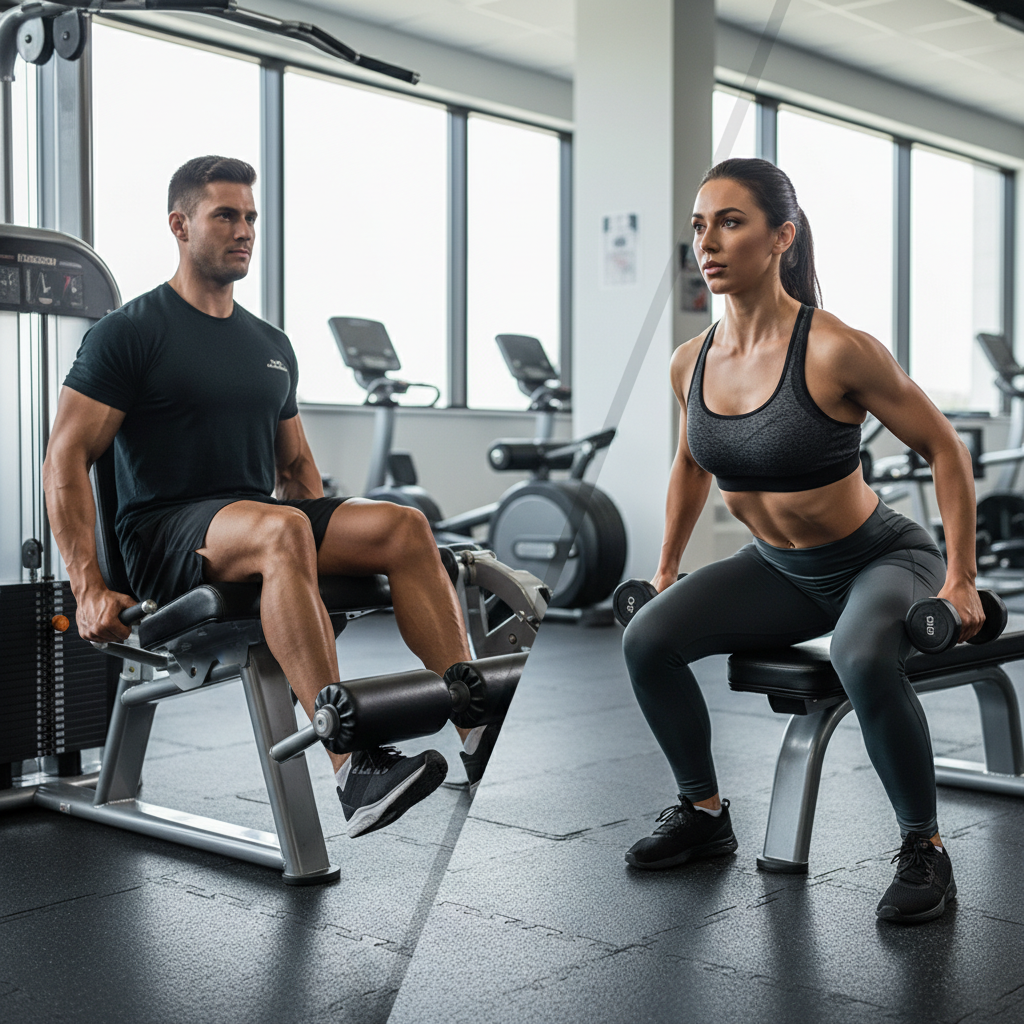
The Leg Extension is the definition of an isolation exercise. It is an open-chain movement, meaning your foot is not fixed against a surface and is free to move. The movement involves a single joint: the knee. As you sit on the machine and extend your lower leg against a padded lever, you are performing pure knee extension. This action almost exclusively targets the quadriceps femoris, the large group of four muscles on the front of your thigh:
- Rectus Femoris: The only quad muscle that crosses both the knee and hip joint.
- Vastus Lateralis: The outer portion of the quad, contributing to the 'sweep'.
- Vastus Medialis: The inner teardrop-shaped muscle, crucial for knee stability.
- Vastus Intermedius: Located beneath the rectus femoris.
Because the machine provides stability and the movement isolates a single joint, there is minimal involvement from your glutes, hamstrings, or core. All the force is channeled directly into the quads, allowing for a highly targeted stimulus.
The Bulgarian Split Squat (BSS), on the other hand, is a compound, unilateral exercise. It's considered a 'hybrid' chain movement, as the front foot is planted (closed-chain) while the rear foot is elevated and less active. This exercise involves simultaneous movement at multiple joints, primarily the knee and the hip. As you descend, your front leg's quad and glute work eccentrically to control the movement, and concentrically to drive you back up. Because it's a free-weight exercise performed on one primary leg, it demands a tremendous amount of work from stabilizer muscles. The primary movers are:
- Quadriceps: Heavily involved in extending the knee to stand up.
- Gluteus Maximus and Medius: The glute max extends the hip, while the glute medius works overtime to stabilize the pelvis and prevent your knee from caving inward (valgus collapse).
Furthermore, your hamstrings act as dynamic stabilizers, your adductors assist, and your entire core (abdominals, obliques, and lower back) must fire to maintain an upright posture and prevent your torso from twisting. This makes the BSS a far more complex and systemically demanding exercise.
The Case for Leg Extensions: Precision, Pump, and Pre-Exhaust
While often dismissed by functional fitness purists, the leg extension machine holds a valuable place in a well-rounded training program, particularly for those focused on hypertrophy (muscle growth).
The primary advantage of the leg extension is its unparalleled ability to isolate the quadriceps. By removing the need for balance and stability, you can focus 100% of your mental and physical effort on contracting the target muscle. This can significantly enhance the mind-muscle connection, a crucial factor in stimulating muscle growth. For bodybuilders, this precision tool is invaluable for carving out detail and separation in the quads and developing the coveted 'teardrop' of the vastus medialis.
From a programming perspective, leg extensions are incredibly versatile. They are less systemically fatiguing than a heavy BSS or barbell squat, meaning you can add more direct quad volume to your workout without overwhelming your central nervous system. This makes them perfect for two specific techniques:
- Pre-Exhaustion: Performing leg extensions before your main compound lift (like squats). This fatigues the quads so that during the squats, your quads will be the limiting factor, ensuring they receive maximum stimulus before your glutes or lower back give out.
- Finisher: Performing leg extensions at the end of your workout. After your heavy compound work is done, you can use the leg extension to safely take the quads to absolute failure, chasing a metabolic-stress-induced pump that contributes to hypertrophy.
Finally, the leg extension plays a significant role in rehabilitation settings. Under the guidance of a physical therapist, it allows for controlled, progressive loading of the quadriceps after injuries or surgery, such as an ACL reconstruction. The ability to manipulate the load and range of motion with precision is something free weights cannot offer. However, it's crucial to acknowledge the debate around shear forces at the knee. While modern research suggests it's safe for healthy knees when performed correctly, individuals with pre-existing knee pain should be cautious, use controlled reps, and avoid excessively heavy loads. Always consult a professional and review our health disclaimer and PAR-Q screening before starting a new exercise regimen, especially if you have a history of injury.
The Power of the Bulgarian Split Squat: Functional Strength and Athleticism
If the leg extension is a scalpel, the Bulgarian Split Squat is a Swiss Army knife. Its benefits extend far beyond just building bigger quads, making it a favorite among athletes and those seeking real-world strength.
The BSS is a fundamentally functional movement. It builds strength, stability, and coordination in a single-leg stance, which has direct carryover to nearly every athletic activity: running, jumping, changing direction, and climbing. By forcing each leg to work independently, it exposes and corrects strength imbalances between your left and right sides, a critical factor in injury prevention and performance optimization. You can find a detailed guide on how to perform it correctly in our exercise library.
This unilateral demand places a massive stability challenge on the hip and core. Your gluteus medius, a key hip stabilizer, works tirelessly to keep your pelvis level and your knee tracking properly over your foot. Your core must brace intensely to keep your torso upright. This integrated training builds a rock-solid pillar of strength that supports all your other heavy lifts, from squats to deadlifts.
From a muscle-building standpoint, the BSS is an efficiency king. In one movement, you're hammering your quads, building your glutes, and engaging your hamstrings and core. This makes it an incredible 'bang for your buck' exercise, perfect for those with limited time. By slightly altering your torso lean—a more upright posture emphasizes the quads, while a slight forward lean brings more glutes into the movement—you can subtly shift the focus to target different areas of your lower body.
The Science of Quad Growth: Which Is Superior for Hypertrophy?
So, the big question remains: which exercise actually builds more quad muscle? The primary driver of muscle growth is mechanical tension. Both exercises are capable of creating significant tension in the quads, but they do it in different ways.
Research comparing single-joint (isolation) and multi-joint (compound) exercises often shows that both can produce similar levels of hypertrophy in the prime movers when volume is equated. However, there's a crucial nuance when it comes to the quadriceps. A 2021 study in the *Journal of Strength and Conditioning Research* by Zabaloy et al. found that while both squats and leg extensions led to significant quad growth, squat variations were superior for growth in the upper (proximal) part of the quads, while leg extensions may be more effective for the lower (distal) part near the knee.
The most important piece of the puzzle is the rectus femoris. As a biarticular muscle crossing both the hip and knee, it is not optimally trained in deep squatting movements. During a squat or BSS, as the knee flexes (lengthening the muscle at the knee), the hip also flexes (shortening it at the hip). This phenomenon, known as 'active insufficiency,' means the rectus femoris doesn't get fully stretched under load. The leg extension, however, keeps the hip in a fixed, flexed position while the knee extends. This allows for superior lengthening and loading of the rectus femoris, and studies have consistently shown that leg extensions are superior for hypertrophying this specific quad muscle compared to squats.
Therefore, for the most complete and well-rounded quad development, relying solely on compound movements like the BSS might leave gains on the table by undertraining the rectus femoris. The leg extension specifically addresses this gap.
Programming and Application: Making the Right Choice
The 'versus' in the title is a false dilemma. The best approach for most people is not choosing one over the other, but understanding when to use each. Your choice should be dictated by your goals, experience, and overall program structure.
You should prioritize Bulgarian Split Squats if:
- Your primary goal is athletic performance and functional strength.
- You want the most efficient, time-saving exercise for overall lower body development (quads and glutes).
- You need to correct strength imbalances between your legs.
- You want to improve your balance, coordination, and core stability.
You should prioritize Leg Extensions if:
- Your primary goal is maximizing quadriceps hypertrophy, especially the rectus femoris.
- You want to add targeted quad volume without accumulating significant systemic fatigue.
- You are using advanced techniques like pre-exhaustion or finishers.
- You are working around an injury (with medical clearance) that limits your ability to perform heavy, weight-bearing compound lifts.
The 'Why Not Both?' Strategy
For the individual seeking maximum muscle growth and a balanced, powerful physique, the answer is to integrate both movements into your routine. A well-structured leg day within one of our training programs often follows a logical hierarchy:
- Primary Strength Movement: Start with your heaviest, most systemically demanding compound lift (e.g., Barbell Squats).
- Secondary/Unilateral Movement: Follow up with a functional compound exercise like the Bulgarian Split Squat or Lunges to work each leg independently and address stability.
- Targeted Isolation Movement: Finish your quads with Leg Extensions to isolate the muscle, target the rectus femoris, and accumulate metabolic stress.
- Posterior Chain Work: Conclude with exercises for your hamstrings and glutes (e.g., Romanian Deadlifts, Leg Curls, Hip Thrusts).
This structure allows you to build a foundation of functional strength with the BSS while using the leg extension as a precision tool to maximize hypertrophy. They are not competitors; they are partners in the pursuit of powerful legs. One builds the engine, the other polishes the chassis. By understanding their unique roles and implementing them intelligently, you can move beyond the simplistic 'versus' debate and start building a truly impressive and capable lower body.