The Most Powerful Exercise You're Probably Doing Wrong
As a sports scientist with over two decades of experience, I've seen countless fitness trends come and go. Yet, one tool has remained a constant in the world of serious strength and conditioning: the kettlebell. And its signature move, the kettlebell swing, stands as one of the most potent, full-body exercises you can perform. It's a ballistic, power-generating movement that builds a rock-solid posterior chain, skyrockets your heart rate, and melts fat. But there’s a catch: a vast majority of people perform it incorrectly, robbing themselves of the benefits and dramatically increasing their risk of injury.
The swing is not a squat. It is not a front raise. It's a pure, explosive hip hinge. Understanding this distinction is the key that unlocks the true power of the kettlebell. In this definitive guide, we will deconstruct the swing, analyze the biomechanics, correct the common errors, and teach you how to master this foundational movement for unparalleled results in power, endurance, and physique transformation.
The Engine Room: Why the Hip Hinge is Everything
Before you ever pick up the bell, you must master the movement pattern that powers the swing: the hip hinge. The powerful muscles of your posterior chain—your glutes and hamstrings—are the engine. Your arms are merely ropes, and your core is the rigid transmission that transfers force. The swing trains your body to generate horizontal force, a critical component of sprinting, jumping, and nearly every athletic endeavor.
Let's contrast this with the common errors:
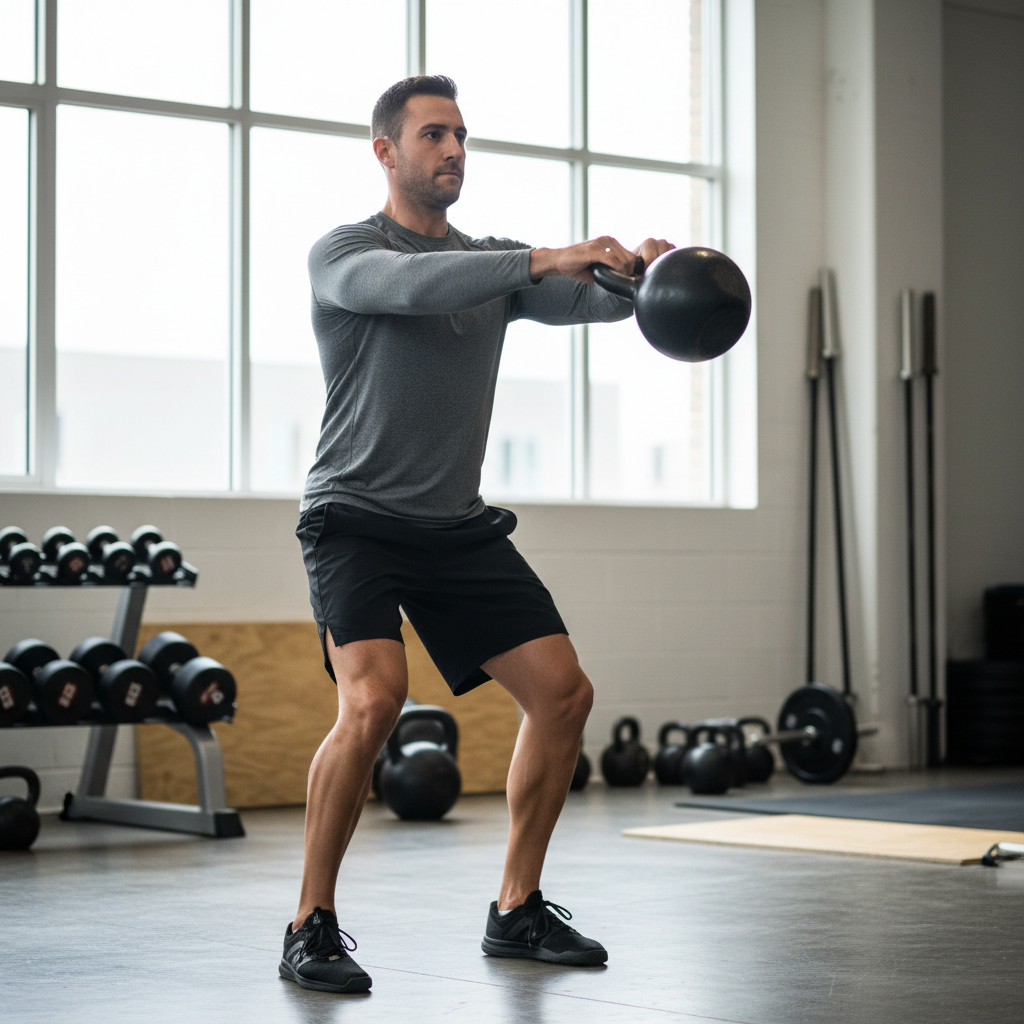
- The Squat-Swing: This happens when the athlete bends their knees too much and drops their hips vertically. The work is done by the quads, not the powerful glutes and hamstrings. The movement becomes a labored, inefficient lift rather than an explosive snap.
- The Arm-Raise Swing: Here, the hips do very little, and the athlete uses their shoulders and arms to muscle the kettlebell up. This severely limits the weight you can use and places dangerous strain on the shoulder joint and lower back.
The perfect swing is a testament to biomechanical efficiency. By hinging at the hips, you load your hamstrings and glutes like a powerful spring. The explosive, forward thrust of the hips—a movement pattern identical to a standing broad jump—is what propels the bell forward and up. Your core must remain braced and your spine neutral to safely transfer this immense power. This is functional training in its purest form.
The Five Phases of the Kettlebell Swing
Mastering the swing is about internalizing its rhythm. We can break it down into five distinct phases. For a visual reference of this and other foundational movements, be sure to explore our complete exercise library.
- The Setup: Place the kettlebell about a foot in front of you. Stand with your feet slightly wider than shoulder-width. Hinge at your hips, keeping your back flat, and grip the bell with both hands. Your shins should be nearly vertical.
- The Hike Pass: Actively “hike” the bell back and high between your thighs, as if snapping a football. Your forearms should make firm contact with your upper inner thighs. This pre-loads the hamstrings and glutes for the explosion to come. Do not let the bell hang low.
- The Hip Snap: This is the moment of truth. As the bell reaches its backmost point, violently snap your hips forward by squeezing your glutes and hamstrings. Think of it as a powerful hip thrust. The force should be so explosive that the kettlebell is propelled forward and upward with no help from your arms.
- The Float: As the bell travels up, your body should form a rigid, standing plank from your ankles to your head. Your core is tight, your glutes are squeezed, and your quads are engaged. The bell “floats” momentarily at chest height, weightless, because of the power you generated. Your arms are relaxed, acting only as guides—we call this the 'T-Rex arms' cue.
- The Descent: As gravity takes over, let the bell swing back down. Instead of resisting it, guide its path and let its momentum push your hips back into the next hinge. Absorb the force with your hamstrings and glutes, ready to immediately transition into the next explosive hip snap.
Avoiding Common Pitfalls: Swing Sins to Purge
Even with the steps clear, bad habits can creep in. Here are the most common mistakes and how to fix them for good. Remember, form must always come before intensity or weight.
- Mistake: Squatting the movement.
The Fix: Practice the hip hinge without a weight. Stand a few inches from a wall, facing away from it. Hinge back until your glutes touch the wall, then thrust your hips forward to stand up. This drills the horizontal movement pattern.
- Mistake: Using your arms and shoulders.
The Fix: Use the 'T-Rex arms' cue—keep your elbows soft and close to your body. If you feel a burn in your shoulders, you're lifting with your arms. The weight is likely too light, encouraging you to muscle it up. A heavier bell forces you to use your hips.
- Mistake: Hyperextending the lower back at the top.
The Fix: At the top of the swing, your body should be a straight line. The goal is a standing plank, not a backward arc. Focus on bracing your abs as if you're about to take a punch and squeeze your glutes hard. This locks your pelvis and lumbar spine in a safe, neutral position.
- Mistake: Starting too light or going too heavy.
The Fix: A bell that's too light teaches bad habits (arm-lifting). A bell that's too heavy breaks form and risks injury. A good starting point for men is often 16kg (35lbs) and for women is 8-12kg (18-26lbs). Progressive overload is key, but it must be earned through perfect technique, not ego. While not used for swings, understanding your strength with tools like our One Rep Max Calculator can help you grasp the principles of progressive loading for other lifts in your program.
Programming the Swing: When and How?
The kettlebell swing is incredibly versatile. It can be a warm-up, a strength builder, or a brutal metabolic finisher. How you program it depends on your goals.
For Power and Strength: Use a heavier bell for lower-rep sets. For example, 5-8 sets of 5-10 powerful reps with ample rest (60-90 seconds) between sets. This focuses on maximal force production in each and every rep.
For Conditioning and Fat Loss: This is where the swing truly shines. High-rep protocols are fantastic for jacking up your metabolic rate. Try these:
- EMOM (Every Minute on the Minute): Perform 10-15 swings at the top of every minute for 10-20 minutes. The remaining time in each minute is your rest.
- Tabata Intervals: 20 seconds of all-out swings followed by 10 seconds of rest, repeated for 8 rounds (4 minutes total).
- Swing Ladders: Perform 2 swings, rest. Perform 4 swings, rest. Continue up to a set of 20, then work your way back down.
Incorporating kettlebell training can dramatically improve your overall fitness. For structured routines that intelligently program swings alongside other complementary exercises, check out the options in our training programs.
The Swing as a Foundational Skill
Mastering the kettlebell swing is more than just learning an exercise; it's about reclaiming a fundamental human movement pattern. It teaches you how to generate explosive power from your hips, build a resilient posterior chain, and forge a high-performance metabolic engine. It protects your lower back by teaching your glutes and hamstrings to do the heavy lifting, a skill that translates to everything from picking up groceries to setting a new deadlift PR.
Take the time to own the technique. Film yourself, practice the drills, and prioritize form over everything else. The reward is access to one of the single most effective exercises for building a powerful, lean, and athletic body that lasts a lifetime. As always, ensure you are cleared for vigorous exercise; you can review our health disclaimer and PAR-Q screening before beginning any new fitness regimen.