As a sports scientist, I've seen countless training splits, but the Push/Pull/Legs (PPL) routine remains one of the most effective and popular for a reason: it’s logical, efficient, and fantastic for building a balanced physique. Today, we're diving deep into one of its core components: the Push Day. This is your blueprint for forging a powerful chest, broad shoulders, and strong triceps.
A push day consolidates all the upper-body muscles that you use in a pushing motion. This synergistic approach allows you to train these muscle groups with high intensity and then give them ample time to recover while you focus on pulling or leg exercises on subsequent days. This article will provide a complete guide, from the underlying anatomy to a sample workout featuring one of the best shoulder-builders ever invented.
The Anatomy of the Push
To train muscles effectively, you must first understand what they are and what they do. Your push day primarily targets three key muscle groups:
- Pectorals (Chest): Comprised of the pectoralis major and minor, your chest muscles are responsible for horizontal adduction (think hugging or bringing your arms together) and pushing movements away from your body. A well-developed chest is the cornerstone of a powerful upper body.
- Deltoids (Shoulders): This three-headed muscle gives your shoulders their round, capped look. The anterior (front) deltoid helps with raising your arm forward, the lateral (side) deltoid is responsible for raising your arm out to the side, and the posterior (rear) deltoid helps pull your arm backward. While all three are active in pressing, specific exercises are needed to ensure balanced development.
- Triceps Brachii: Located on the back of your upper arm, the triceps make up roughly two-thirds of its mass. Their primary function is elbow extension—straightening your arm. They are a crucial synergist in every single pressing movement, from a bench press to a push-up.
Understanding this functional anatomy allows us to select exercises that target these muscles optimally, leading to better strength gains and hypertrophy (muscle growth).
Mastering the Arnold Press: The 3D Shoulder Secret
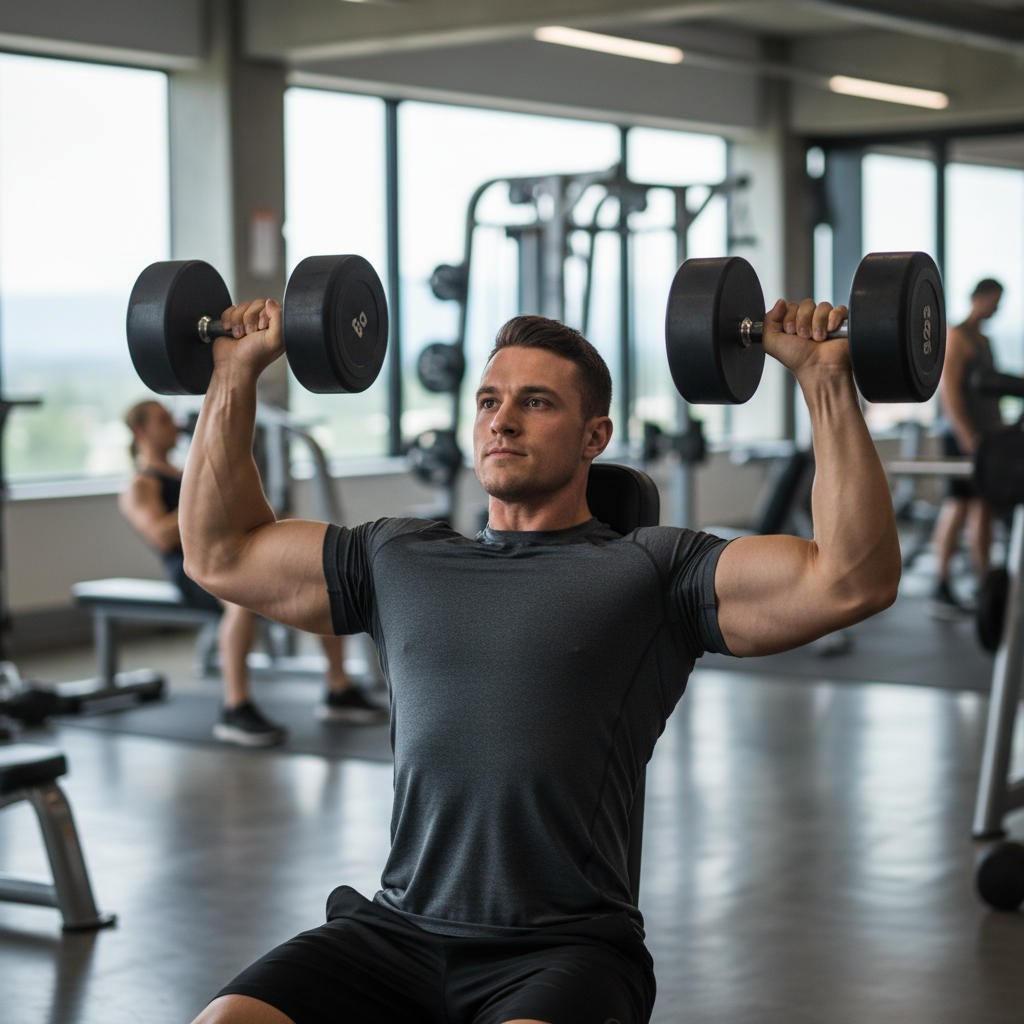
While the standard overhead press is a fantastic exercise, if you want to build truly three-dimensional shoulders, you need to master the Arnold Press. Named after the legendary Arnold Schwarzenegger, this exercise is unique because it incorporates rotation, moving the shoulder through multiple planes of motion and engaging all three heads of the deltoid more effectively than a standard press.
The magic is in the rotation. The initial part of the movement, with palms facing you, heavily involves the anterior deltoid. As you press and rotate, the lateral deltoid takes over to drive the weight up and out, creating shoulder width. The entire movement requires stability and control, contributing to overall shoulder health and function when performed correctly.
How to Perform the Arnold Press:
Follow these steps for perfect form. Remember, start with a lighter weight than you would for a standard dumbbell press to master the mechanics.
- Starting Position: Sit on a bench with back support. Hold two dumbbells in front of your shoulders with your palms facing your body and your elbows bent, as if at the top of a bicep curl.
- The Press & Rotation: Begin to press the dumbbells upward. As the dumbbells pass eye level, start rotating your palms so they face forward. This should be one fluid, controlled motion—don't just flip your wrists.
- The Peak: Continue pressing until your arms are fully extended overhead, with the dumbbells nearly touching and your palms facing forward. Your biceps should be next to your ears. This is the top of the movement.
- The Negative & Reverse Rotation: Slowly reverse the movement. As you lower the dumbbells, rotate your palms back to the starting position (facing your body). Lower the weight with control, don't just let it drop.
For a visual guide on this and other key movements, our comprehensive exercise library is an invaluable resource for ensuring your technique is flawless.
The Complete Push Day Workout
Now, let's put it all together into a challenging and effective workout. This routine is designed to build a foundation of strength with compound movements, followed by isolation work to maximize hypertrophy.
Warm-up (5-10 minutes): Start with light cardio (e.g., jogging, cycling) followed by dynamic stretches like arm circles, torso twists, and band pull-aparts.
- 1. Barbell Bench Press (or Dumbbell Bench Press): 3 sets of 6-8 reps. This is your primary strength-building chest movement. Focus on progressive overload here.
- 2. Arnold Press: 3 sets of 8-12 reps. Your main shoulder builder. Focus on controlled rotation and a full range of motion.
- 3. Incline Dumbbell Press: 3 sets of 10-12 reps. The incline angle places more emphasis on the upper clavicular fibers of the pectoral muscle, helping to build a fuller-looking chest.
- 4. Dumbbell Lateral Raises: 3 sets of 12-15 reps. This isolation exercise is crucial for targeting the lateral deltoid to build shoulder width. Control is everything; avoid using momentum.
- 5. Triceps Pushdowns (Cable): 3 sets of 10-15 reps. A great isolation movement to target all three heads of the triceps. Keep your elbows pinned to your sides.
- 6. Chest Dips (or Bench Dips): 2 sets to failure. An excellent bodyweight finisher that hits the chest and triceps hard. Go for as many quality reps as you can.
Rest: Take 60-90 seconds of rest between sets. For a detailed breakdown of this routine, check out our full workout library.
Progressive Overload: The Key to Growth
Simply showing up and going through the motions isn't enough for long-term progress. The single most important principle for getting stronger and building muscle is progressive overload. This means continually challenging your muscles to do more than they are accustomed to.
You can achieve this in several ways:
- Increase the Weight: The most straightforward method. Once you can comfortably hit the top end of your rep range for all sets, it's time to increase the load.
- Increase the Reps: If you're not ready to jump up in weight, try adding one or two more reps to each set with the same weight.
- Increase the Sets: Add an extra set to one or more of your exercises to increase total training volume.
- Decrease Rest Time: Reducing your rest periods makes the workout more metabolically demanding and can spur new adaptations.
Tracking your workouts is crucial for implementing progressive overload effectively. Note your exercises, weights, sets, and reps for every session. To set appropriate working weights based on your current strength, you can use tools like our One Rep Max Calculator to get a reliable estimate.
While this single workout is a powerful tool, consistency and long-term planning are what create lasting change. For a more structured, long-term approach to your fitness journey, consider exploring our professionally designed training programs.
Finally, always listen to your body. Proper form is non-negotiable and is more important than lifting heavy. Before beginning any new exercise routine, it is essential to consult our health disclaimer and PAR-Q screening and consider speaking with a qualified healthcare professional. Now, go build that powerful upper body.