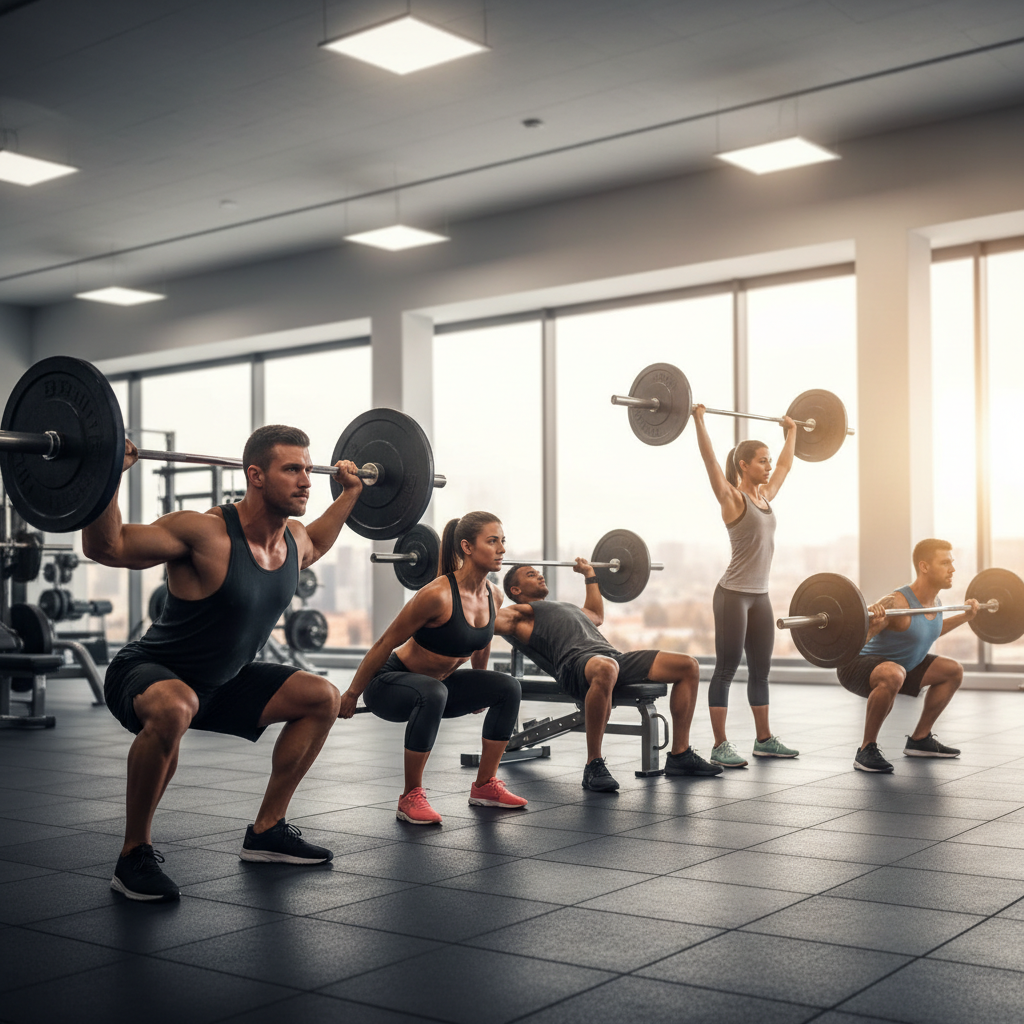
In the vast universe of exercises, it's easy to get lost. Should you be doing isolation curls or cable flyes? What about the latest machine that promises miraculous results? While variety has its place, the bedrock of any truly effective strength training regimen is built upon a handful of core movements. These are the compound lifts: multi-joint exercises that recruit massive amounts of muscle, stimulate a powerful hormonal response, and build real-world, functional strength. At SmartyGym, we believe in training smarter, not just harder. Mastering these five foundational pillars will provide more value than any combination of 20 isolation exercises.
The Science of Compound Dominance
Why do we champion compound lifts over single-joint exercises? The answer lies in efficiency and biology. When you perform a movement like a squat or deadlift, you're not just working one muscle; you're orchestrating a symphony of muscular contractions across your entire body. This has several profound effects. Firstly, it creates a much larger metabolic demand. Your body must burn significantly more calories to fuel and recover from a heavy set of squats compared to a set of leg extensions. This makes compound lifts a superior tool for fat loss and body recomposition.
Secondly, the stress of heavy, multi-joint loading triggers a potent hormonal cascade. Your body responds by increasing its production of anabolic hormones like testosterone and growth hormone. These are the key players in building muscle and strength. Finally, compound lifts build intermuscular coordination. They teach your muscles to work together as a cohesive unit, which translates directly to improved performance in sports and the activities of daily life — from carrying groceries to moving furniture. They are the epitome of functional training.
Pillar 1: The Squat - The King of Lifts
No exercise builds lower body strength and muscle mass quite like the barbell back squat. It's a full-body movement that heavily targets the quads, glutes, and hamstrings while demanding a braced core and stable upper back. A well-executed squat is a true display of strength.
- Setup: Position the bar on your traps (not your neck). Grip the bar firmly, pull your shoulder blades together to create a stable "shelf," and un-rack the weight. Take 2-3 steps back and establish your stance, typically with feet shoulder-width apart and toes pointed slightly out.
- Descent: Take a deep breath and brace your core as if you're about to be punched. Initiate the movement by breaking at the hips and knees simultaneously. Think of sitting back and down between your heels. Keep your chest up and your gaze neutral.
- Ascent: Once your hips are at or just below parallel with your knees, drive through your whole foot (imagine pushing the floor away) to stand back up. Exhale forcefully as you approach the top.
Common faults include caving knees (valgus collapse) and letting the chest fall forward. Focus on driving your knees out and keeping your torso upright. For a visual demonstration of proper squat form, check out our comprehensive exercise library.
Pillars 2 & 3: The Posterior & Anterior Powerhouses
The deadlift and the bench press are two iconic lifts that build formidable strength in the posterior and anterior chains, respectively.
The Deadlift: If the squat is king, the deadlift is the emperor. It builds raw, whole-body strength, targeting the glutes, hamstrings, entire back, lats, and grip. The key to a safe and powerful deadlift is the hip hinge. With the bar over the middle of your feet, hinge at your hips, keeping a flat back, until you can grip the bar. To lift, drive the floor away with your legs and pull, keeping the bar close to your body. Think of it as a push with the legs first, then a pull with the back. Never jerk the weight or allow your lower back to round.
The Bench Press: The quintessential upper-body push, the bench press is the ultimate measure of chest, shoulder, and triceps strength. Proper setup is crucial. Lie on the bench with your feet flat on the floor, and arch your lower back slightly while keeping your glutes on the bench. Pull your shoulder blades together and down. This creates a stable base and protects your shoulders. Lower the bar to your mid-chest in a controlled manner, and then press it explosively back to the starting position.
Pillars 4 & 5: Building Shoulders and a Strong Back
Rounding out our five pillars are two movements that are essential for balanced development and a powerful physique: the Overhead Press and the Barbell Row.
The Overhead Press (OHP): Often neglected, the strict OHP is the truest test of upper body pressing strength. It builds powerful shoulders, triceps, and requires immense core stability. Standing with the bar in a front rack position, brace your core and glutes tightly. Press the bar straight overhead, pushing your head "through the window" created by your arms at the top. Lower it with control. Avoid using leg drive (that would be a push press) to keep the focus on the shoulders.
The Barbell Row: To balance out all that pressing and build a thick, powerful back, the barbell row is non-negotiable. It's the direct antagonist to the bench press. Hinge at your hips, maintaining a flat back similar to a deadlift position. Pull the bar towards your lower chest/upper abdomen, squeezing your shoulder blades together at the top of the movement. This builds the lats, rhomboids, traps, and biceps, contributing to better posture and a stronger pull in all other activities.
Integrating The Pillars Into Your Training
Mastering these lifts requires a structured approach. The principle of progressive overload is paramount — you must continually challenge your body by adding weight, reps, or sets over time. A great way to begin is by focusing on two or three of these lifts per session, a few times per week. For instance, a common setup is pairing a lower body lift (Squat/Deadlift) with an upper body lift (Bench Press/OHP/Row).
Not sure where to start with weight selection? A great starting point is to use our One Rep Max Calculator to estimate your strength levels and work with percentages. For example, you might work with 3-4 sets of 5 repetitions at 80-85% of your estimated 1RM. While you can build your own routine, following one of our professionally designed training programs can take the guesswork out of progression and ensure you're training effectively and safely.
Ultimately, these five pillars are more than just exercises; they are fundamental human movements. By building your training around them, you're not just lifting weights — you're building a stronger, more resilient, and more capable body for life. As always, prioritize your health and safety. We recommend reviewing our health disclaimer and PAR-Q screening before starting any new fitness regimen.