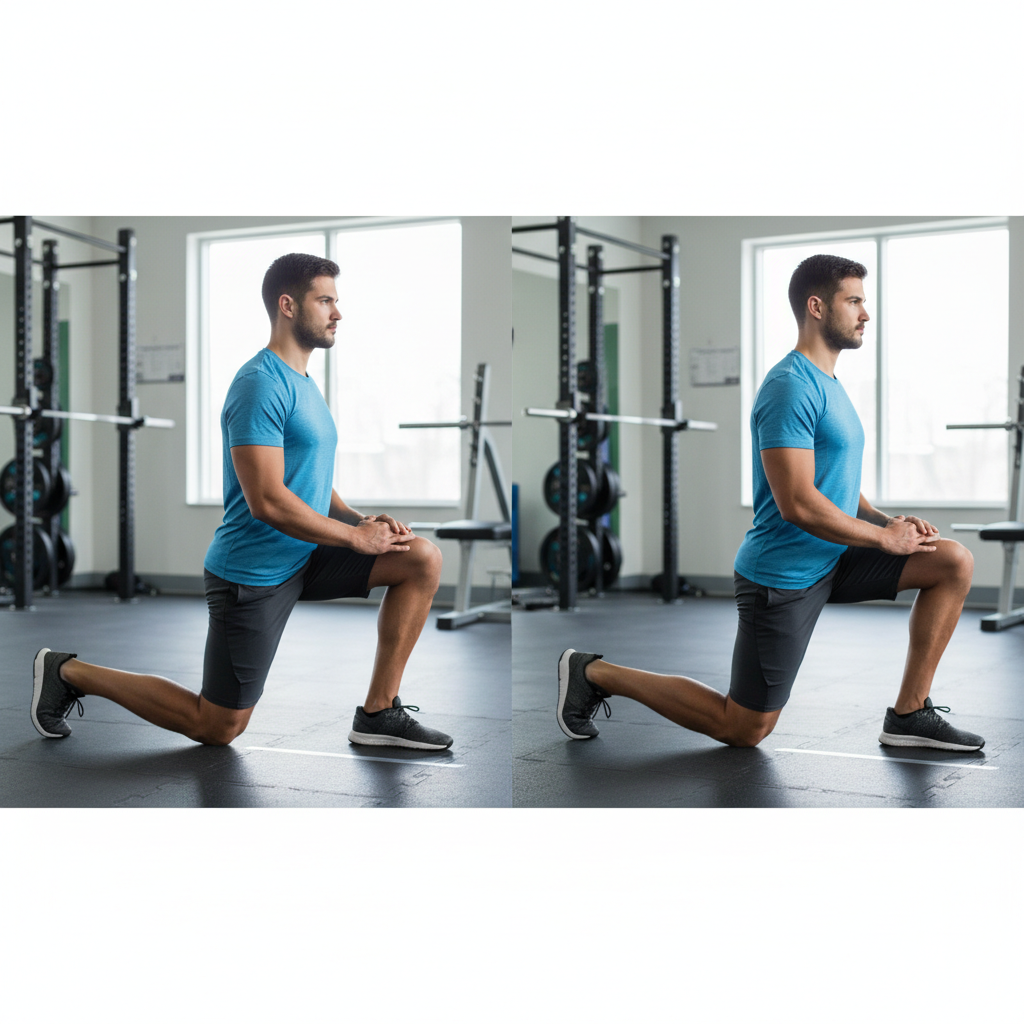
The lunge is a non-negotiable cornerstone of any serious strength program. As a fundamental unilateral movement, it exposes and corrects imbalances, builds functional strength, and sculpts powerful legs. But within the lunge family, a classic debate rages on: which is superior, the forward lunge or the reverse lunge? While they may seem like two sides of the same coin, their biomechanical differences have significant implications for muscle growth, joint health, and athletic performance.
As a sports scientist, I'm here to dissect these two powerhouse exercises. We'll move beyond gym-floor opinion and look at the evidence to help you decide which lunge variation deserves a prime spot in your routine. The answer, as you'll see, isn't about picking a winner, but about understanding the right tool for the job.
The Biomechanics Breakdown: A Tale of Two Movements
To understand which lunge to choose, we first need to grasp how they differ mechanically. The direction you step initiates a cascade of kinetic changes that alters muscle recruitment and joint stress.
The forward lunge is a deceleration-dominant movement. When you step forward, your body's center of mass travels with you, and you must then use the muscles of your lead leg to brake that momentum. This puts a significant eccentric load on the quadriceps and requires a great deal of stability and control to prevent the front knee from traveling too far forward or caving inward. The return to the start position requires a powerful push off the front foot.
Conversely, the reverse lunge is an acceleration-dominant movement. By stepping backward, your center of mass remains largely over your front foot. The front leg stays planted, creating a stable base of support. This position naturally encourages a deeper hip hinge, and the return to the start involves driving through the front foot to pull the body forward. This makes the movement less about braking and more about controlled lowering and powerful concentric drive.
Muscle Activation: Quads vs. Glutes
While both lunge variations work the entire lower body—quadriceps, glutes, hamstrings, and adductors—the mechanical differences create a distinct shift in muscular emphasis.
Due to the forward momentum and braking force, the forward lunge places a greater demand on the quadriceps, particularly the rectus femoris. As your body works to decelerate and stabilize your knee, your quads fire intensely. This makes it an excellent choice if your primary goal is building the muscles on the front of your thighs.
The reverse lunge, on the other hand, tends to be more posterior chain dominant. Because the front foot is anchored and the torso can more easily remain upright, it facilitates a greater hip hinge. This movement pattern increases the involvement of the gluteus maximus and hamstrings. The stability of the reverse lunge allows you to focus on driving through the heel of the front foot, which is a key cue for activating the glutes. For individuals looking to build a stronger, more developed posterior chain, the reverse lunge is often the superior choice.
Joint Health and Stability: The Knee-Friendliness Factor
This is where the distinction between the two movements becomes most critical, especially for beginners or those with a history of knee pain. The deceleration component of the forward lunge creates significant shear forces across the knee joint and places more stress on the patellar tendon.
If performed with imperfect form—a common issue for even experienced lifters—it's easy for the knee to travel too far past the ankle, exacerbating these forces. For this reason, many coaches and physiotherapists are cautious about programming heavy forward lunges.
The reverse lunge is inherently more knee-friendly. By keeping the front shin more vertical and reducing the need to brake momentum, it significantly lessens the shear forces acting on the knee. This stability makes it a much safer option for learning the lunge pattern and for loading heavily with reduced risk of joint aggravation. If you have sensitive knees, prioritizing the reverse lunge is a smart training decision. However, pain is complex, so it's crucial to listen to your body and review our health disclaimer and PAR-Q screening before trying a new exercise, especially if you have prior injuries.
Programming: When to Use Each Lunge
Choosing the right lunge depends entirely on your goals, experience level, and individual biomechanics. Neither is universally "better," but one is likely better for you.
Here’s a simple guide to help you decide:
- Use Forward Lunges for:
- Athletic Development: Athletes in sports like basketball, tennis, and football that require rapid deceleration will benefit from the forward lunge's specific training stimulus.
- Targeted Quad Hypertrophy: If your quads are a lagging body part and your knees are healthy, the forward lunge is a potent tool for growth.
- Variety and Coordination: For advanced lifters, it can be a way to challenge motor control and add variety to a stale routine.
- Use Reverse Lunges for:
- Beginners: It's the ideal variation for teaching the fundamental lunge pattern safely and effectively.
- Glute and Hamstring Development: It's one of the best exercises for targeting the posterior chain in a unilateral fashion.
- Strength and Hypertrophy: The enhanced stability allows for greater progressive overload with heavier weights, making it a fantastic builder of overall leg mass and strength.
- Warm-ups: Bodyweight reverse lunges are an excellent way to activate the hips and prepare the body for heavier lower-body work.
Visualizing the correct form is essential for safety and effectiveness. You can find detailed video tutorials for both the forward and reverse lunge, along with dozens of other variations, in our complete exercise library.
The Verdict: Which Lunge Reigns Supreme?
After breaking down the mechanics, muscle activation, and joint-stress implications, a clear picture emerges. While the forward lunge holds value for specific athletic applications, the reverse lunge is the more versatile, safer, and arguably more effective variation for the vast majority of fitness goals.
Its knee-friendly nature, superior stability, and enhanced glute and hamstring activation make it an outstanding choice for building a strong, balanced, and resilient lower body. It's easier to learn, safer to load, and delivers phenomenal results for both strength and hypertrophy.
This doesn't mean you should banish the forward lunge forever. A well-rounded regimen can and should include variety. However, if you're building the foundation of your leg training, the reverse lunge should be your default choice. For structured routines that intelligently incorporate the best exercises for your goals, explore the expertly designed SmartyGym training programs.
Ultimately, the best lunge is the one you can perform correctly, consistently, and without pain. Master the reverse lunge first, build a strong foundation, and then you can earn the right to explore more advanced variations like the forward lunge to further challenge your body.