
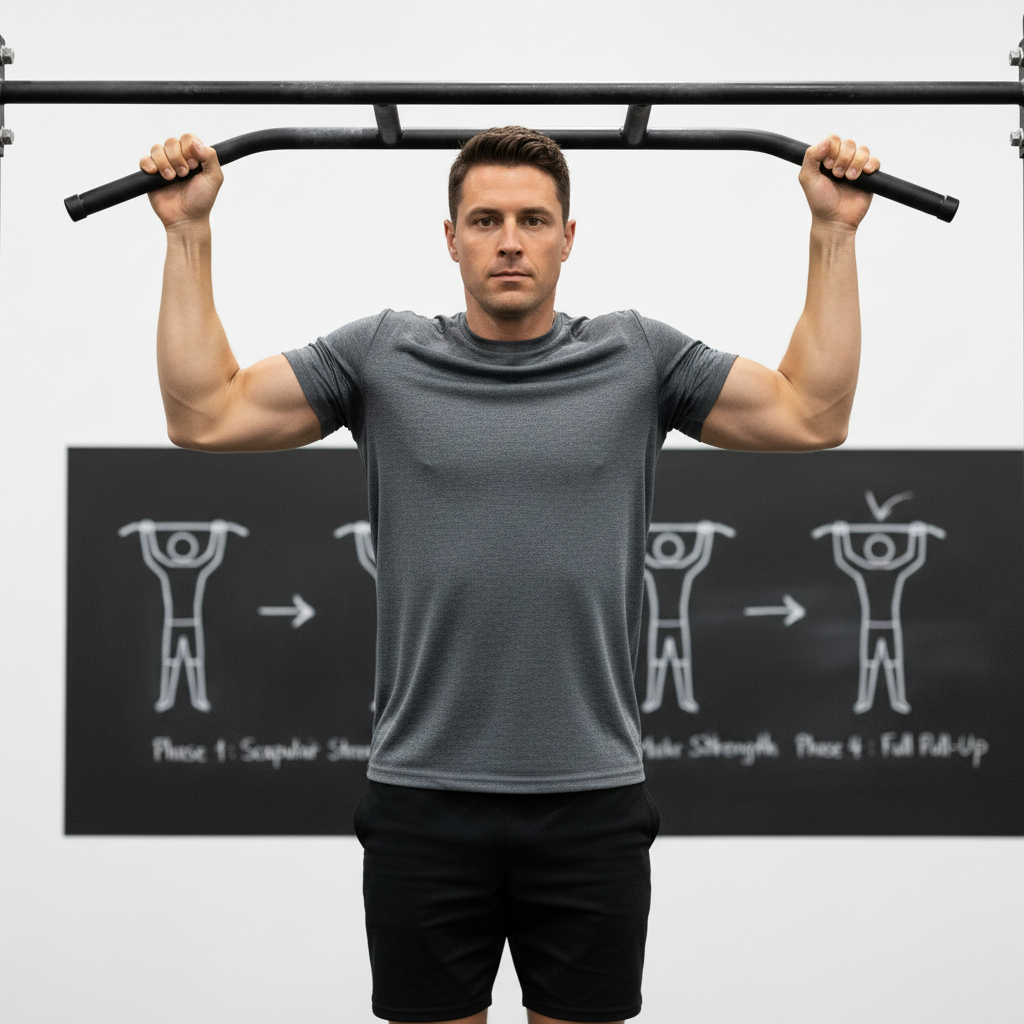
The pull-up is often regarded as the gold standard of upper-body strength. It is a closed-chain movement that demands total-body tension, vertical pulling power, and exceptional grip strength. However, for many fitness enthusiasts, the journey from hanging on the bar to clearing it with the chin feels insurmountable. As a sports scientist, I have seen that the barrier is rarely a lack of effort, but rather a lack of structured, progressive overload tailored to the specific biomechanics of the movement.
The Biomechanics of the Vertical Pull
To master the pull-up, we must first understand the primary movers involved. The latissimus dorsi are the main drivers, but successfully completing a rep requires the synergistic cooperation of the rhomboids, trapezius, posterior deltoids, and the brachialis. Furthermore, your core must maintain a 'hollow body' position to prevent energy leaks. Many beginners fail because they treat the pull-up as purely an arm exercise, neglecting the powerful muscles of the back. Before starting any high-intensity routine, ensure you have reviewed our health disclaimer and PAR-Q screening to ensure you are ready for strenuous physical activity.
Phase 1: Establishing Foundation with Scapular Strength
The first step toward a pull-up isn't pulling; it’s hanging. Most trainees lack scapular stability. You must be able to control your shoulder blades independently of your arms. Start with 'Scapular Pulls': hang from the bar with straight arms and practice pulling your shoulder blades down and back, lifting your chest slightly without bending your elbows. This movement recruits the lower trapezius and prepares the joints for the stress of a full hang. Aim for 3 sets of 10-15 controlled repetitions. Strengthening these stabilizers reduces the risk of impingement and ensures that when you do start pulling, the lats are primed to take the load.
Phase 2: Building Relative Strength with Rows and Negatives
If you cannot lift your body weight yet, you must build the capacity through horizontal pulling and eccentric loading. Horizontal rows (using a barbell or rings) allow you to pull a percentage of your body weight while your feet remain supported. Once you can comfortably perform 12-15 inverted rows, move to Eccentric Negatives. Use a box to jump to the top of the pull-up position, then lower yourself as slowly as possible—aiming for a 5 to 10-second descent. Studies in hypertrophy and strength acquisition show that the eccentric (lowering) phase creates significant neurological adaptations, allowing you to handle weights that exceed your current concentric (pulling) max. You can find visual demonstrations for these variations in our exercise library.
Phase 3: Assisted Variations and Accessory Volume
Resistance bands or assisted pull-up machines are excellent tools to bridge the gap. Bands provide the most help at the bottom—the mechanically weakest point of the lift—and decrease assistance as you reach the top. However, do not rely on them indefinitely. To ensure you are making progress, you can track your increasing strength levels by comparing your accessory lifts to your goals using our One Rep Max Calculator for weighted row variations. This helps quantify your strength-to-weight ratio improvements over time.
The Role of Grip and Core Tension
One of the most overlooked aspects of the pull-up is grip endurance. If your hands give out before your lats, you will never reach the volume needed for growth. Incorporate 'Dead Hangs' into your routine to build forearm robustness. Additionally, the 'Hollow Body' hold—a gymnastic staple—is crucial. By engaging your abs and glutes, you create a rigid 'lever' that is much easier to pull than a limp, swinging body. Think of the pull-up as a moving plank; the more internal tension you create, the more force you can transfer into the bar.
Programming Your Success
Consistency is the final piece of the puzzle. You should treat the pull-up as a skill, not just a workout finisher. Practice 2-3 times per week, alternating between high-intensity eccentric days and higher-volume assisted days. If you are looking for a structured way to integrate these movements into a full-body routine, explore our comprehensive training programs designed by experts. Remember, the journey from zero to one is the hardest; once you achieve that first strict rep, the path to five, ten, and fifteen becomes a matter of refined volume and progressive loading. Stay patient, optimize your mechanics, and own the bar.