Anchor Point Flow
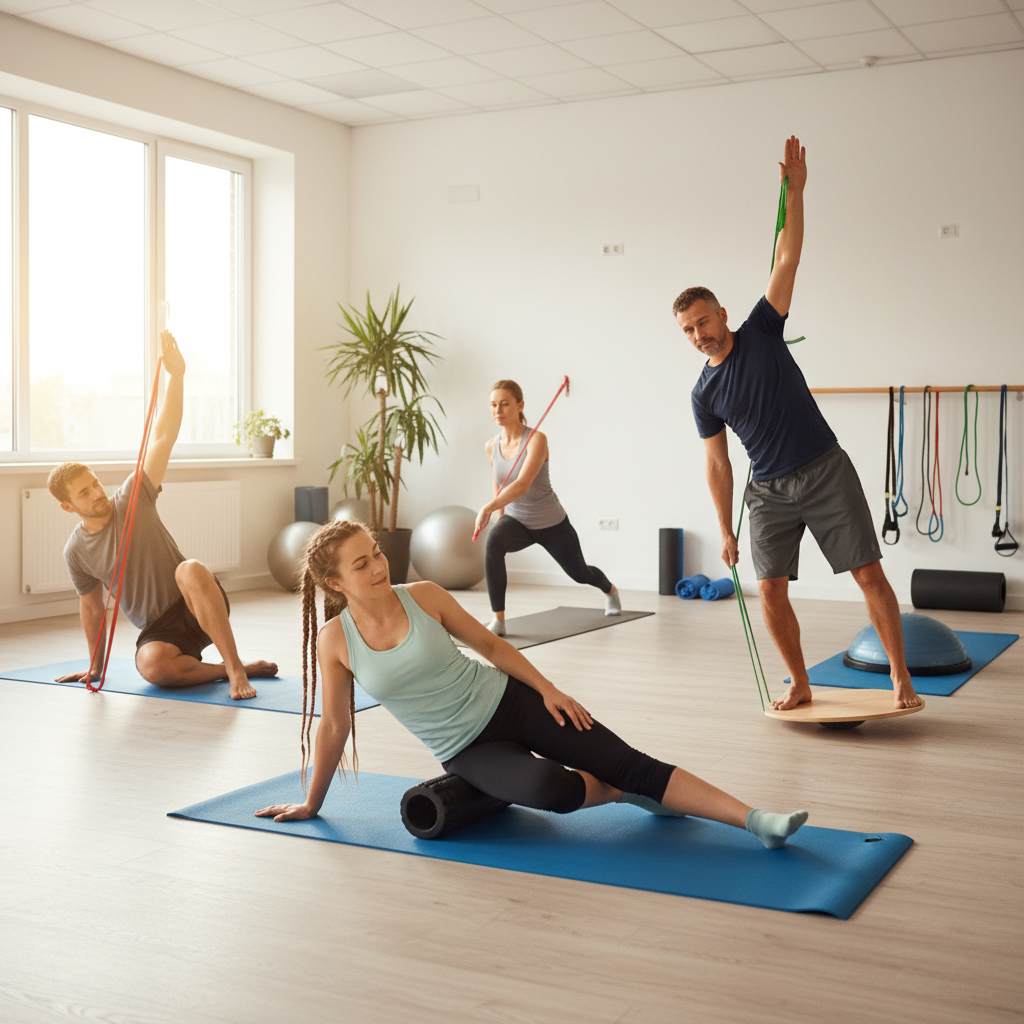
This beginner mobility and stability workout focuses on building a strong foundation and improving body control. Each exercise is carefully selected to enhance joint range of motion and core stability, promoting better movement patterns and injury prevention. You'll learn to engage your muscles effectively through controlled movements, establishing a solid base for more advanced training.
Main Workout
🧽 Soft Tissue Preparation 5'
Foam roll hip flexors and quads (30-45 sec per side)
Foam roll hamstrings and glutes (30-45 sec per side)
Foam roll upper back and lats (30-45 sec per side)
🔥 Activation 15'
3 reps {{exercise:0257:circles knee stretch}} (each side)
3 reps {{exercise:clamshell:Clamshell}} (each side)
3 reps {{exercise:bird-dog:Bird Dog}} (each side)
2 reps {{exercise:1471:inchworm}}
💪 Main Workout (REPS & SETS)
3 reps {{exercise:0597:lever seated hip abduction}} (controlled tempo)
3 reps {{exercise:0598:lever seated hip adduction}} (controlled tempo)
3 reps {{exercise:1452:lever seated crunch}} (slow and controlled)
3 reps {{exercise:0573:lever back extension}} (controlled, full range)
3 reps {{exercise:0581:lever high row}} (controlled, focus on scapular retraction)
Rest 60-90 seconds between sets.
⚡ Finisher (10 minutes)
Set a 10-minute clock. Complete smooth quality rounds with no rushing and rest only as needed.
40 seconds {{exercise:0276:dead bug}}
12 reps {{exercise:3013:low glute bridge on floor}}
30 seconds each side {{exercise:1363:spine stretch}}
10 reps {{exercise:0662:push-up}}
🧘 Cool Down 10'
{{exercise:1511:hamstring stretch}}
{{exercise:1576:leg up hamstring stretch}} — 30 sec hold
{{exercise:1713:assisted prone lying quads stretch}} — 30 sec hold
{{exercise:1424:seated glute stretch}} — 30 sec hold
{{exercise:1363:spine stretch}} — 30 sec hold
Diaphragmatic Breathing (2 min): Lie supine, {{exercise:3679:sit-up with arms on chest}} , one on belly. Slow inhale through nose (belly rises), slow exhale through mouth. Focus on calming nervous system.
Instructions
Soft Tissue Preparation: Use a foam roller to address any tightness in your hips, legs, and back. Spend extra time on areas that feel particularly stiff.
Activation: Focus on precise, controlled movements to wake up your core and stabilizing muscles. Maintain a steady pace and feel each muscle working.
Main Workout: Perform each exercise with a slow and controlled tempo, emphasizing the connection with the targeted muscles. For the seated ab/adduction, use a weight that allows you to complete all reps with good form.
Finisher: This section reinforces core stability and glute activation. Concentrate on holding the plank with a rigid body and squeezing your glutes at the top of the hip raises.
Cool Down: Hold each stretch for the prescribed duration, focusing on deep breathing to relax into the stretch. Finish with diaphragmatic breathing to calm your nervous system and promote recovery.
Tips
Tip 1: Slow and Steady Wins the Race: For mobility and stability, rushing through movements defeats the purpose. Focus on perfect form over speed.
Tip 2: Mind-Muscle Connection: Actively think about the muscles you're working. This helps improve neurological pathways and enhances stability.
Tip 3: Breathe Through It: Use your breath to aid in movement and stretching. Exhale as you move into a stretch or during the concentric phase of an exercise.
Tip 4: Consistency is Key: Regular mobility and stability work, even just for a few minutes daily, yields significant long-term benefits.