First Strict Pull-Up: A Coach's Progression
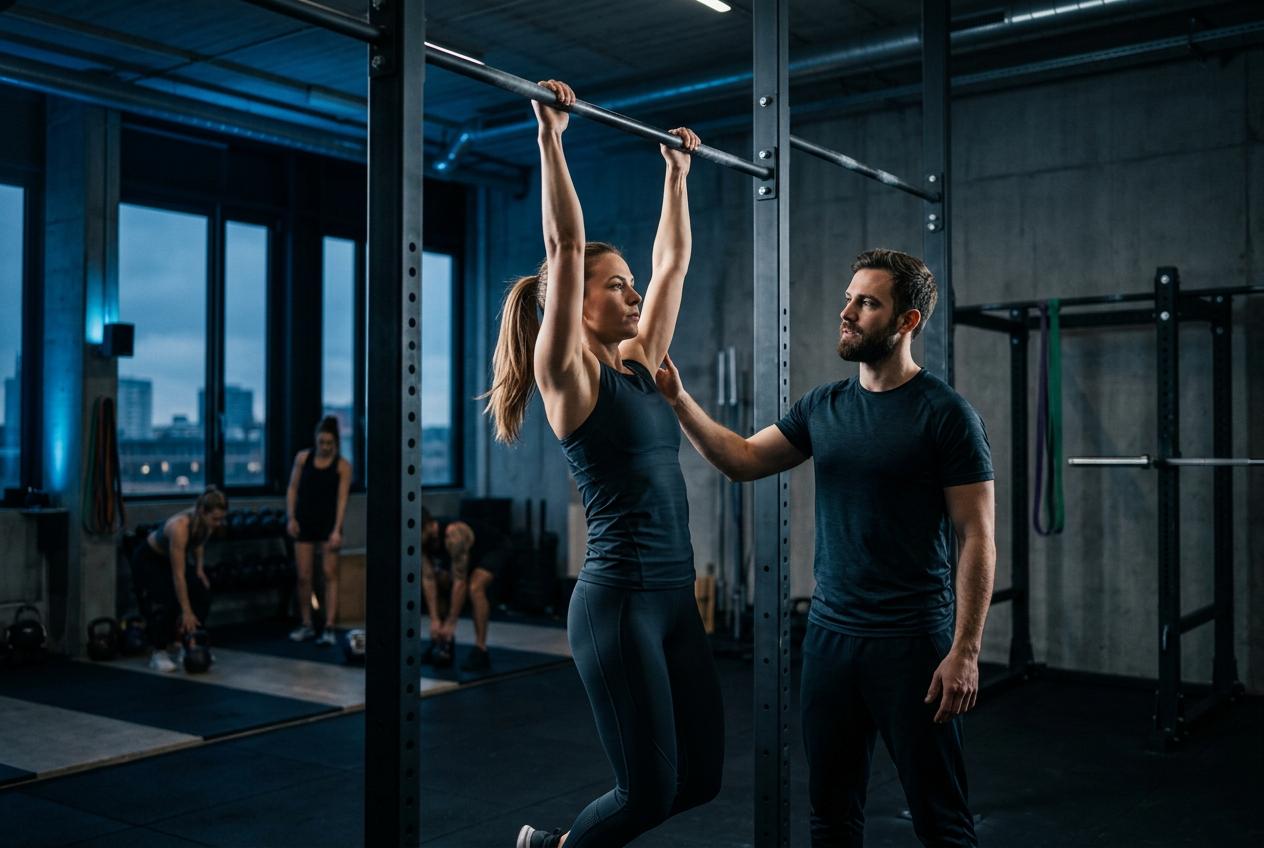
In my twenty-five years of coaching athletes and gym-goers, few milestones carry the psychological and physical satisfaction of a first strict pull-up. It is the gold standard of relative upper-body strength. Unlike machine pulldowns, where your torso remains static while a load moves toward you, a pull-up demands that your central nervous system coordinate an open-chain kinetic movement into a closed-chain expression of total body tension.
Yet, millions of trainees find themselves stuck in a perpetual purgatory of elastic band assists or avoided attempts. The reason is rarely a lack of desire; it is almost always an absence of systematic biomechanical progression. If you want to conquer the bar, you must stop guessing and start applying sports science.
The Biomechanics: Why the Pull-Up Is So Demanding
To pull your entire body mass against gravity from a dead stop, several muscular systems must fire in precise synchrony. The prime movers are the latissimus dorsi, teres major, and biceps brachii, assisted significantly by the brachialis and brachioradialis. However, the movement fails most frequently not at the elbows, but at the shoulder girdle.
A strict pull-up requires robust scapulohumeral rhythm. Before the arms bend, the shoulder blades must transition from upward rotation and elevation into depression and retraction. This initial setting of the scapulae relies heavily on the lower and middle trapezius, rhomboids, and serratus anterior. Furthermore, without rigid anterior core engagement—creating a slight hollow-body position—energy leaks through an arched lumbar spine, dramatically increasing the mechanical disadvantage of the lats.
Phase 1: Building Foundational Grip and Scapular Integrity
Before you ever attempt to pull your chin over the bar, you must earn the right to hang from it safely. Ligamentous integrity and grip endurance form the non-negotiable base of your pull-up foundation.
- Active Dead Hangs: Grip the bar slightly wider than shoulder-width using a full, thumb-around grip. Engage the forearms and lats by pulling your shoulder blades down away from your ears without bending your elbows. Aim to accumulate 3 sets of 30 to 45 seconds. You can time your sets precisely using our workout timer.
- Scapular Pull-Ups: From a passive hang, initiate movement solely by depressing and retracting your scapulae, lifting your chest upward by two to three inches while keeping your arms straight. Pause for two seconds at the top, then control the descent. Perform 3 sets of 8 to 10 repetitions.
These drills wake up dormant lower trapezius fibers and reinforce shoulder centration, safeguarding your rotator cuff against impingement when pulling loads increase.
Phase 2: Horizontal Pulling and Isometric Strength
A common error I observe in training programs is attempting to develop vertical pulling power exclusively through vertical variations. In reality, horizontal pulling builds the mid-back musculature that stabilizes the torso during the pull-up.
The inverted row is your greatest ally here. By elevating your feet or adjusting bar height, you can scale the load while practicing full retraction of the scapulae at the apex of the pull. Focus on driving your elbows back and pulling your sternum to the bar, pausing for a full second at peak contraction.
Simultaneously, incorporate flexed-arm hangs. Step onto a box, position your chin above the bar, grip tightly, step off, and fight gravity to maintain that top position. This drill develops intense motor unit recruitment in the biceps, upper lats, and forearms at the joint angles where pulling leverage is most compromised. Strive for 3 to 4 sets of 10 to 15-second holds with zero hip sway.
Phase 3: The Power of Eccentric Overload
Muscles can produce 20% to 40% more force during the eccentric (lowering) phase of a contraction than during the concentric (lifting) phase. When you cannot yet pull yourself up, you can still control your descent, stimulating rapid neurological and structural adaptations.
Stand on a box or plyo bench beneath the bar. Jump smoothly to the top position with your chin cleared over the bar. Immediately brace your abs and glutes to lock in a hollow-body shape, and begin an agonizingly slow, controlled descent lasting five to six full seconds. Resist the downward pull through the entire range of motion, particularly at the bottom third where the temptation to simply drop is strongest.
Perform 4 to 5 sets of 2 to 3 eccentric repetitions, resting at least 90 to 120 seconds between sets to allow full replenishment of your phosphagen system. You can explore video demonstrations of controlled eccentrics in the SmartyGym exercise library.
The Problem with Resistance Bands
While looped resistance bands are ubiquitous, relying on them exclusively often stunts progress. The biomechanics of an elastic band are inversely matched to the strength curve of a pull-up. A band provides the most assistance at the bottom of the movement—where it is stretched to its limit—and virtually zero assistance at the top, precisely where you need mechanical help to finish chin-over-bar.
This teaches your nervous system to rely on a spring out of the hole, failing to build true starting strength from a dead hang. If you use bands, treat them as an occasional accessory rather than your primary developmental tool. Box-assisted pull-ups, where one toe lightly rests on a support to offload just enough body weight, provide a much more consistent, controllable stimulus across the entire repetition.
Programming Your Path to Success
To achieve your first pull-up, high frequency and low fatigue beat crushing your muscles to failure once a week. The central nervous system learns motor patterns through frequent, crisp exposures.
- Frequency: Train pull-up progressions 3 non-consecutive days per week (e.g., Monday, Wednesday, Friday).
- Volume: Keep repetitions low and execution immaculate. Never perform eccentric work or holds to muscular collapse; stop when your descent speed accelerates uncontrollably.
- Integration: Pair these progressions seamlessly into comprehensive bodyweight workouts or broader upper-body sessions.
Understanding your personal levers, training history, and strength-to-weight ratio dictates how quickly you will progress. See how SmartyGym personalizes training to structure recovery and progressive overload around your individual profile. Stay consistent, respect the physics of human movement, and the bar will yield.