Push-Up Power: Your Guide from Zero to Pro
Why the Push-Up is a Foundational Movement
The push-up is often seen as a simple test of chest strength, but its true value is far greater. When performed correctly, it’s a dynamic, full-body exercise that builds strength, stability, and muscular endurance simultaneously. It’s a closed-chain kinetic exercise, meaning your hands are fixed in place while your body moves. This type of movement is exceptional for building joint stability, particularly in the shoulders, elbows, and wrists, which is a key component of injury prevention in the gym.
Mastering the push-up builds more than just impressive pecs. It requires and develops:
- Core Stability: A push-up is essentially a moving plank. Maintaining a rigid torso from head to heels challenges your entire core musculature, translating to better form on heavy lifts like squats and deadlifts.
- Shoulder Health: Proper push-up form involves the protraction and retraction of your scapulae (shoulder blades), which is crucial for healthy shoulder function and a powerful bench press.
- Triceps and Deltoid Strength: These muscles are prime movers in any pressing movement, and push-ups are one of the most effective ways to develop them without external weights.
Ultimately, the push-up is a fundamental display of relative strength—your ability to control and move your own bodyweight. It’s a skill that pays dividends across your entire training journey.
The Foundation: Perfect Form First
Before you attempt your first full push-up, you must establish a solid foundation. Rushing into the movement with poor form not only limits your progress but also invites shoulder and lower back pain. We need to build the chassis before we install the engine. The two non-negotiable starting points are the plank and scapular control.
First, master the High Plank. Position your hands directly under your shoulders, press the ground away, and create a straight line from your head to your heels. Engage your core by bracing as if you're about to be punched in the stomach, and squeeze your glutes to stabilize your pelvis. Avoid letting your hips sag or rise too high. This tension is the key to a strong push-up.
Next, practice Scapular Push-Ups. From that perfect plank position, without bending your elbows, pinch your shoulder blades together, allowing your chest to sink slightly. Then, push your shoulder blades apart, doming your upper back. This small movement isolates and strengthens the serratus anterior, a critical muscle for shoulder stability. You can find detailed video demonstrations for exercises like these in the SmartyGym exercise library to ensure your form is precise.
The Progression Ladder: From Wall to Floor
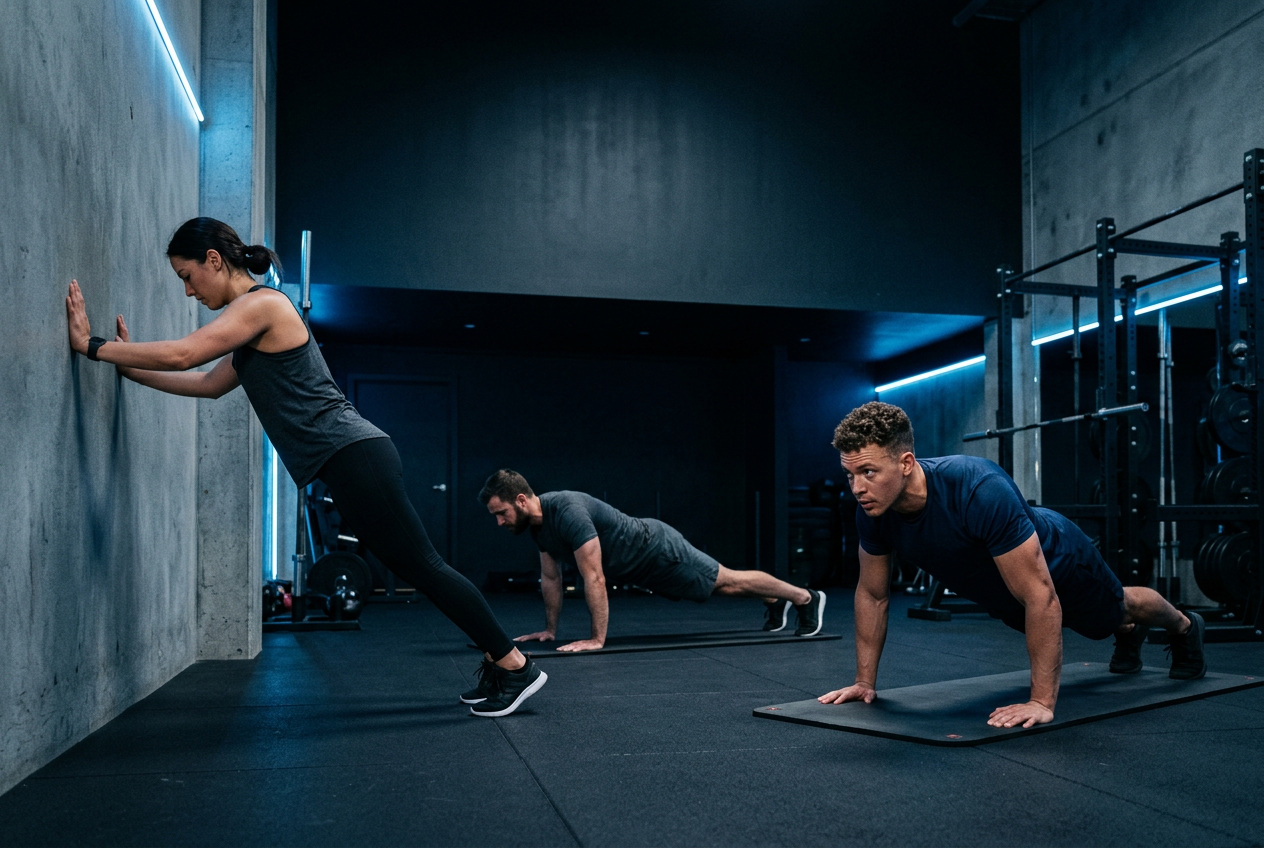
Progress isn't about struggling through sloppy reps; it’s about mastering one level of difficulty before earning the right to attempt the next. This systematic approach ensures continuous improvement. Here is the ladder you will climb. Aim for 3 sets of 10-15 well-executed reps at each stage before moving on.
- Wall Push-Ups: Stand facing a wall, about arm's length away. Place your hands on the wall, slightly wider than your shoulders. Keeping your body in a straight line, bend your elbows and lower your chest towards the wall. Press back to the start. This is the lowest-intensity version and perfect for absolute beginners.
- Incline Push-Ups: Find a sturdy, elevated surface like a kitchen counter, a park bench, or a barbell in a squat rack. The higher the surface, the easier the exercise. The form is identical to a standard push-up—hands under shoulders, core tight, full range of motion. As you get stronger, gradually decrease the incline to increase the challenge.
- Knee Push-Ups: Often incorrectly dismissed, the push-up from the knees is a valuable tool when done right. The mistake most people make is hinging at the hips, creating a V-shape. Instead, maintain a straight line from your head to your knees. Your hips should lower with your chest. This variation effectively reduces the amount of bodyweight you have to lift.
- Negative Push-Ups: This is where you build serious strength. Start in a high plank position and lower yourself down as slowly and controlled as possible, aiming for a 3-5 second descent (the eccentric phase). Once your chest touches the floor, you can drop to your knees to push yourself back up to the starting plank position. Eccentric training is scientifically proven to be highly effective for building muscle and strength.
- The Full Push-Up: Once you can control your negative for several reps, you're ready. From a high plank, lower your body as a single unit until your chest is just above the floor. Maintain full-body tension. Press forcefully back to the start, achieving full elbow extension without letting your hips sag. Congratulations, you've just done a perfect push-up.
Level Up: Beyond the Standard Push-Up
Mastering the bodyweight push-up is a huge milestone, but it's not the end of the road. To continue making progress via progressive overload, you need to introduce new challenges. Instead of just chasing more reps, try incorporating these advanced variations into your routine.
- Tempo Push-Ups: Manipulate the speed of your reps. Try a 3-1-1-0 tempo: 3 seconds to lower, a 1-second pause at the bottom, 1 second to push up, and 0-second pause at the top. This increases time under tension, a key driver of muscle growth. Use our workout timer to keep your tempo strict.
- Decline Push-Ups: Elevate your feet on a bench or box. This shifts more emphasis to your upper chest and shoulders, significantly increasing the difficulty.
- Weighted Push-Ups: Once your form is flawless, add external load. Have a partner carefully place a weight plate on your upper back, or wear a weighted vest for an even distribution of resistance.
- Plyometric Push-Ups: To build explosive power, push up from the bottom with enough force for your hands to leave the ground. You can start with an explosive push and progress to a full clap push-up.
Putting It All Together: Your Push-Up Plan
To integrate this into your training, replace your current push-up exercise with the variation on the ladder that you can perform for 3 solid sets of 8-12 reps. Once you can comfortably hit 3 sets of 15, it's time to move to the next progression. The key is consistency and honest assessment of your ability.
This method of mastering a movement pattern and then systematically increasing the difficulty is the core philosophy behind intelligent training. It’s exactly how SmartyGym builds your personalized workouts. Our AI analyzes your performance on every single exercise, understands when you've mastered a certain level, and automatically progresses you to the next logical step—whether it's a more advanced variation, more reps, or more weight. We take the guesswork out of progressive overload so you can focus on what matters: your effort.
Start where you are, respect the process, and you'll build the strength and skill to master this timeless exercise.